
In This Article
Two Kinds of Systems
In Louisiana, a home’s septic system almost always falls into one of two categories, and which one your buyer is looking at changes everything about how it should be inspected, maintained, and budgeted for.
A conventional system is the older, simpler design. Wastewater flows by gravity from the house into a tank, solids settle out, and liquid moves out into a drain field where the soil finishes the job. There are no moving parts, no electricity, and very little to break. As long as the tank gets pumped on schedule and the field isn’t driven over or saturated, a conventional system can work quietly for decades.
An aerobic treatment unit (ATU) is the newer, more complex design — and it’s what most newer Louisiana homes on septic actually have. An ATU uses electricity and mechanical components (an aerator, a chlorinator, and often an alarm) to treat wastewater to a higher standard before it disperses. That higher treatment is why Louisiana allows ATUs on smaller lots and in tighter soils where a conventional field wouldn’t work. The trade-off is that an ATU has parts that wear out, electricity that costs money every month, and a service contract that Louisiana law effectively requires for as long as the home is owned.
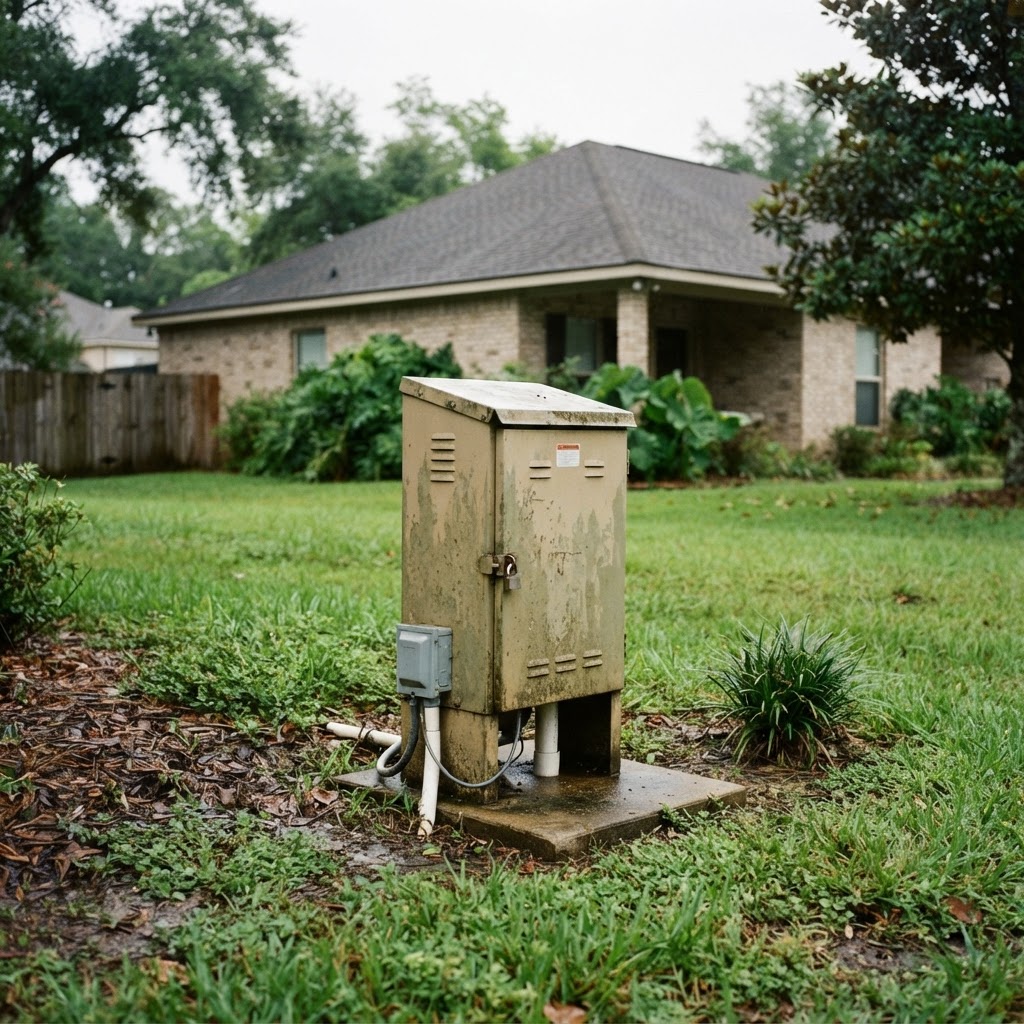
Telling the two apart at a showing isn’t always obvious. A conventional system usually shows only access lids in the yard. An ATU typically has a small cabinet — often near the tank or the house — that houses the aerator controls, and you may hear it humming. If there’s a cabinet, an alarm panel, or a chlorinator tube mentioned in the seller’s paperwork, you’re looking at an ATU.
Helpful Tip
Six Common Defects
When we inspect a septic system, these are the six issues we find again and again. Knowing them ahead of a showing helps you set expectations with your buyer before the inspection report lands.
- Empty chlorinator tube (ATU): The chlorinator is what disinfects the treated effluent before it disperses. When the chlorine tablets run out — and they do, because nobody restocks them — the system is discharging undertreated wastewater.
- Failed or failing aerator (ATU): The aerator is the heart of an ATU. When it stops running, treatment stops. A dead aerator often shows up as an alarm, a silent cabinet, or effluent that doesn’t meet standard.
- Alarm not functioning: ATUs are required to have an alarm that signals aerator failure or high-water conditions. If the alarm has been disconnected, silenced, or simply doesn’t trip when it should, the first warning your buyer would get is a backup in the house.
- Solid waste in the tank: A tank that hasn’t been pumped on schedule fills with solids. Once solids carry over into the drain field, they clog the soil and shorten the field’s life — sometimes dramatically.
- Drain field saturation or failure: A soggy, smelly, or lush-green patch over the field is a red flag. It means the soil can no longer absorb effluent at the rate the household produces it, and the field may need partial or full replacement.
- Surface discharge or runoff issues: On some lots, treated effluent discharges to the surface or to a ditch. If grading, routing, or the dispersal point itself is compromised, effluent can pool, run back toward the home, or leave the property — a health and compliance problem.
Did You Know?
Other Things to Notice at a Showing
You don’t need to inspect the septic system yourself — that’s what the septic inspection is for. But a few things at a showing can tell you whether to expect a clean report or a negotiated repair list, and they help you set your buyer’s expectations early.
Smell. A strong sewage odor near the tank, the field, or the yard isn’t normal for a functioning system. It points to a venting problem, a failing field, or a tank that needs attention.
Standing water or unusually green grass. A patch of lawn over the drain field that’s noticeably greener, spongier, or wetter than the surrounding yard often means effluent is surfacing instead of absorbing. That’s a field problem, not a landscaping perk.
The cabinet and alarm. If the home has an ATU, find the cabinet. Is it humming? Is there an alarm panel, and does the seller know whether it’s ever gone off? A cabinet that’s silent when it should be running, or an alarm that’s been muted, tells you the system may not be getting the attention it needs.
Access and clearance. Can the tank lids and the cabinet actually be reached? A system buried under a deck, a shed, or years of overgrowth costs more to inspect and more to service — and a buyer who can’t service a system can’t maintain it.
None of these replace a septic inspection, but each one is a signal. If you see or smell two of them, tell your buyer up front that the septic inspection is likely to turn up something — and that’s exactly why you ordered it.
The Vacant House Trap
A vacant home can be the hardest septic system to read. When nobody has been running water through the system for weeks or months, everything looks fine on the surface — the tank isn’t full, the field isn’t saturated, and the aerator may not have been under load. An inspection under those conditions can come back clean and still be misleading.
The problem is that a septic system is sized and designed for a household’s daily water use. A vacant home isn’t testing the system the way your buyer will. Once a family moves in and starts running showers, laundry, and dishwashers every day, a field that looked dry during a walkthrough can start surfacing effluent within days. The equipment may be in good condition, but the field’s ability to handle the new household’s actual water volume is the question the inspection can’t fully answer.
“A septic inspection on a vacant home tells you the condition of the equipment. It can’t tell you whether the field can handle your buyer’s actual water use.”
Ask how long the home has been vacant, and share that with your inspector. If it’s been empty for a while, a clean inspection report is a good sign about the equipment — not a guarantee about the field. In that situation, set your buyer’s expectation that the real test begins after move-in, and that’s worth factoring into how aggressively you negotiate repairs.
Essential Documents
A septic system’s paperwork is part of the system. Before closing, ask the seller’s agent for the following — and treat missing documents as a negotiating point, not a formality.
- LDH permit and installation records: The Louisiana Department of Health (LDH) permit for the system confirms it was installed and approved for the number of bedrooms the home claims. A system sized for a two-bedroom home serving a four-bedroom listing is a problem that shows up at resale.
- Maintenance and service records: Pump-out receipts and, for ATUs, the service-contract history. A gap of several years with no record of pumping is a flag; an ATU with no service history is a bigger one.
- Repair history: Any prior aerator replacements, field repairs, or modifications. A system that’s been repaired repeatedly is telling you something about its underlying condition.
- LDH homeowner certification (where applicable): Louisiana allows a homeowner to maintain their own ATU under an LDH-approved homeowner program, with a certification that’s personal to them. If the seller has been maintaining the system under this program, that certification does not transfer to your buyer.
Bonus for the buy side
The most useful document for a buyer’s agent is the most recent service or inspection report. It gives you a snapshot of the system’s condition before your buyer’s own inspection, it shows whether the seller has been keeping up with maintenance, and it gives your inspector a baseline to compare against. If the seller can’t produce one, that’s information too — it usually means the system hasn’t been looked at in a while.
Helpful Tip
Know What Repairs Cost
When the septic inspection turns up a finding, the next question from your buyer is always the same: what’s this going to cost? Having a realistic range in hand helps you advise them on whether to request a repair, a price reduction, or simply walk away.
Quick Look: Common Septic Repairs & Typical Costs
| Repair | Typical Cost |
|---|---|
| Routine pump-out | $350–$600 |
| Aerator replacement | $400–$900 |
| Partial field repair | $1,000–$5,000 |
| Full system replacement | $7,000–$15,000 |
Typical costs are national averages for general budgeting only. Get a local quote before negotiating repairs — costs vary by system type, site access, and local contractor rates. For a local read on a specific system, see our Recommended Contractors.
Write Repair Requests That Hold Up
A vague repair request is easy for a seller to push back on. A specific one, tied to the inspection report and a licensed provider, is much harder to refuse — and it protects your buyer if the work is done poorly.
Instead of “fix the septic system,” name the finding: “Seller to replace the failed aerator and restock the chlorinator tube per the septic inspection report dated [date], performed by a Louisiana-licensed septic contractor, with a service receipt provided to the buyer prior to closing.” That language does four things at once: it identifies the specific defect, it ties the request to the report, it requires a qualified provider, and it creates a paper trail.
For bigger findings — a failing field, an undersized system, a missing LDH permit — a repair credit may make more sense than a seller-side fix, because your buyer can then choose the contractor and oversee the work. Either way, the request should reference the inspection report by date and the specific finding by name. That’s what holds up in negotiations and, if it ever comes to it, in a dispute.
What to Tell Your Buyer at Closing
By closing, your buyer has the inspection report, the negotiated repairs or credits, and a stack of septic paperwork. The single most valuable thing you can do is make sure they leave the table knowing what happens next — because a septic system doesn’t stop needing attention the day they get the keys.
Tell them, in plain terms, what kind of system they have. If it’s an ATU, make sure they understand they need a service contract — not as an option, but as the ongoing cost of owning that system. Confirm whether the seller’s maintenance contract was re-executed in their name, or whether they need to set up their own before move-in.
Give them the pump-out schedule. A conventional tank typically needs pumping every three to five years depending on household size and use; an ATU needs service-contract visits on the contractor’s schedule. Hand them the service and repair records you collected, and tell them to keep every future receipt — the next buyer’s agent is going to ask for them, just like you did.
Finally, tell them what to watch for after move-in: a silent cabinet, an alarm that trips and won’t reset, slow drains, or a soggy patch over the field. Catching a problem early is the difference between a service call and a replacement. That’s the conversation that turns a septic sale from a risk into a managed one — and it’s one of the reasons your buyer will remember you handled it well.
Considering a septic inspection alongside a full home inspection? See our Louisiana Home Inspection →